Too much damage, too many explosions, and a passive tree that grew up
Three problems landed on the same day, and all three were fixed by measuring first.
“With little effort I deal too much damage”
The owner’s complaint. We measured: against a fresh character, a typical one out-damaged monster life by x6 at tier 1, x25 at tier 5 and x130 at tier 10. The biggest single cause was flat “+X damage”, which could roll on all eleven gear slots and was added to a skill’s small base (Fireball 22 became about 146 with a tier-10 set). The general design rule we used after a round of research: whichever curve grows faster eventually wins.
Three changes:
- Gear. Flat added damage only rolls on weapons, rings and the amulet. Skills take it at an added damage effectiveness: Spark 50 %, Fireball 100 %, Meteor 150 %.
- Monster level drives monster stats. A table holds the expected damage of a reference character at each monster level, and monster life = time to kill x that damage. Targets: normal 0.4 s, magic 1.5 s, rare 5 s, unique 10 s, boss 45 s. Resistances rise to 30 % at level 85, armour to 15 % of the reference hit, and each theme resists its own element.
- The bot plays the reference character: gems at the right level, supports, ascendancy and a fresh rare set for the tier, logging time to kill per rarity.
The first table, derived from a paper model, was wrong at both ends: too soft at tier 1 (boss in 19 s) and far too hard from tier 10 (boss 125 s, collapsing at 15 and 20). The model missed that once gems and supports max out around tier 10, only gear keeps the player’s damage growing. After two rescaling passes the Arcanist sits on target at tiers 5 to 20 (rare 5 to 9 s, boss 39 to 64 s). Armour surprised us as well: a “25 % against the reference hit” target cost melee’s smaller hits about 40 %, so it dropped to 15 %. The Warrior bot is still clearly slower than the Arcanist, a class/bot gap we left open.
The frame drop when exploding packs die
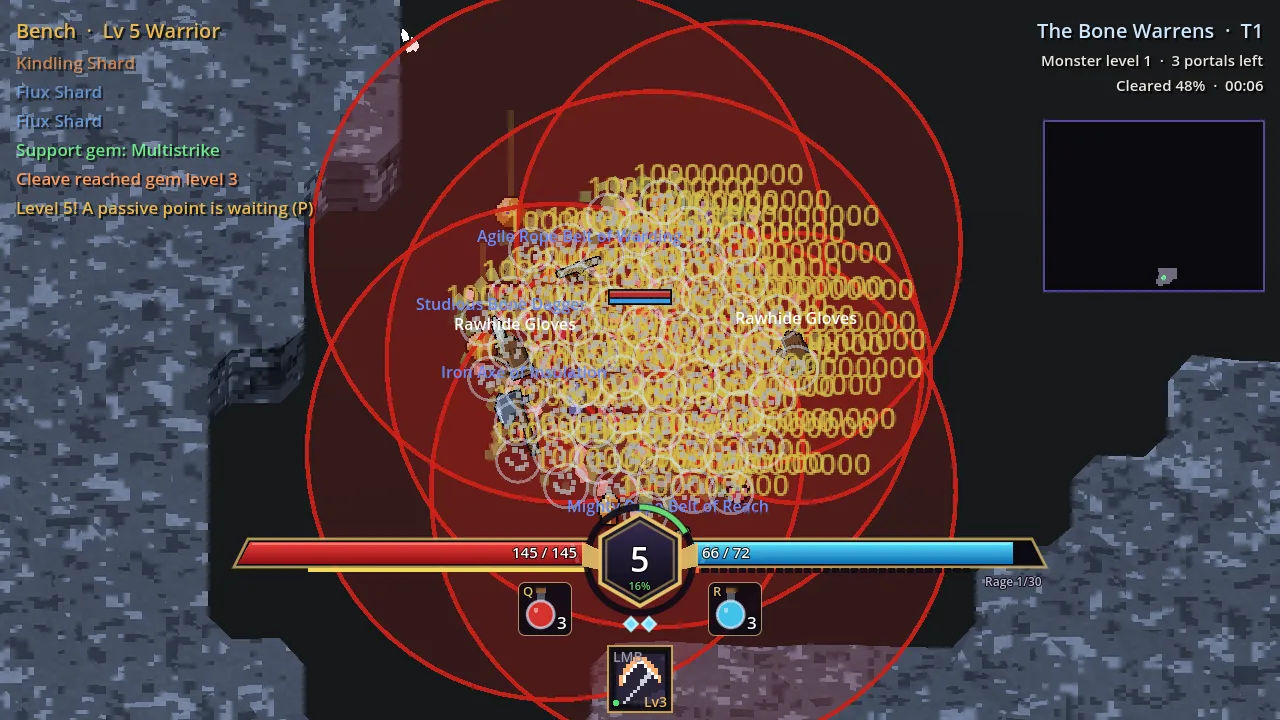
The owner reported a big frame drop when lots of exploding enemies die at once. Before changing anything we built a benchmark that drops 60 monsters on the player, kills them in one frame and logs every frame of the next 2.5 seconds. Headless runs measure the simulation; software-Vulkan runs measure the voxel view.
The biggest cost was not the explosions but the voxel crumbles. Every death read its model back from the GPU to pick cube colours and made its own shadow-casting MultiMesh: 124 ms of CPU in the kill call and +183 draw calls. Cube shapes are now cached per mesh, a frame’s crumbles share one MultiMesh and debris uploads in one call: 18 ms and +4 draws. Damage numbers got pooled, blast puffs capped at 6 per frame, and a 60-pack’s kill frame fell from about 37 to 27 ms headless, with no change in gameplay.
The second pass, with four approved proposals from performance:
- Chain Reaction and Decay explosions wait one frame per hop, so a cascade ripples.
- Volatile blasts land 1.0 s +/- 0.1 s after the death.
- Close blasts draw one merged telegraph per cluster: about 5 outlines for a 60-pack instead of 60 discs.
- The player takes at most one volatile hit every 0.25 s (before, 60 overlapping blasts was 60 hits in one frame, i.e. instant death).
- Drops are rolled on the kill frame but spawn from a queue (2 items or 8 pickups per frame).
Same-session numbers, 60 Slimes, median of 3: the chain-reaction kill frame went from 28 to 7 ms and its worst frame from 25 to 16 ms.
The passive tree grows up
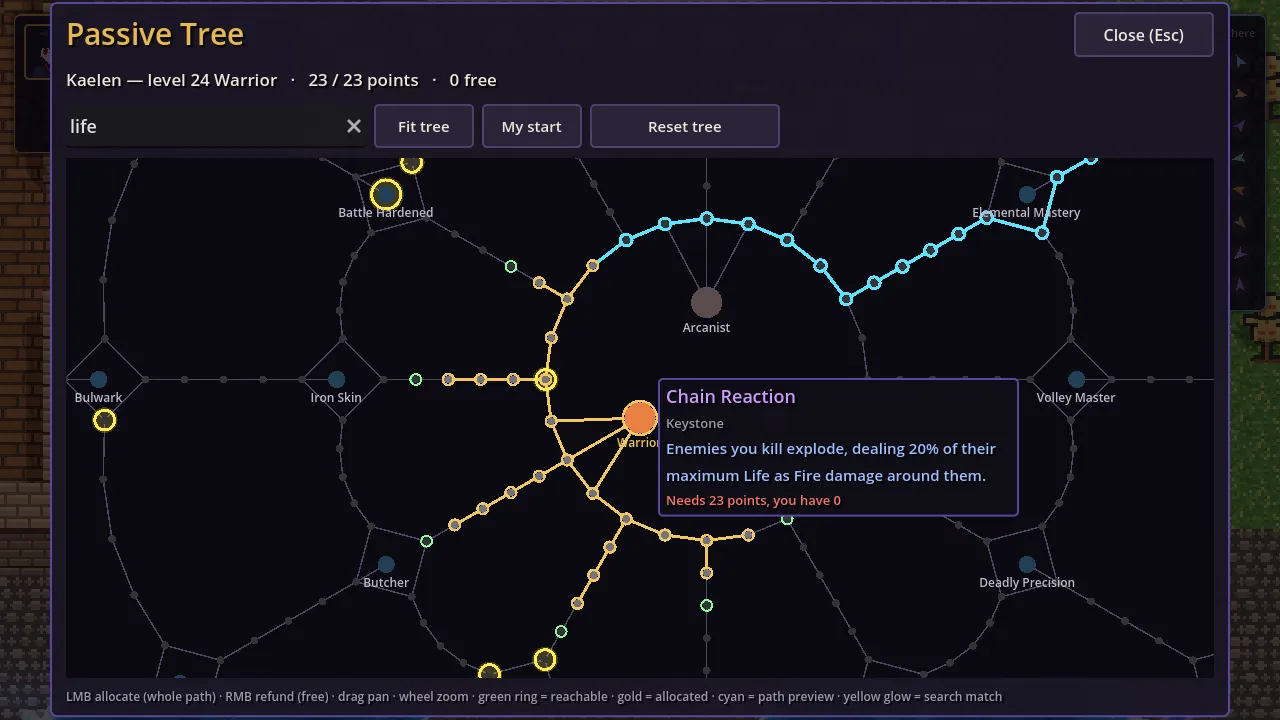
The owner, at level 30, was reaching several branches at once: the old tree had 92 nodes for 69 points. The new one has 339: an inner ring of attribute and utility nodes leads out to 24 “wheels”, each with four themed small nodes looped around a notable, with travel nodes between wheels and twelve keystones on the outer edge. The nearest notable costs about nine points, so at level 30 a character reaches three or four. Related themes sit near each other but never together. Six new mechanics came along (life leech, mana on kill, freeze chance, elemental and physical damage taken) and four keystones.
The panel previews the cheapest path to whatever you hover, with its cost, and allocates the whole path on click. It also has search, fit/centre buttons and a free Reset tree; refunds are free while the tree is play-tested, and characters saved with the old tree silently get their points back.