Four friends in the Rift: co-op, join codes and attacking our own host
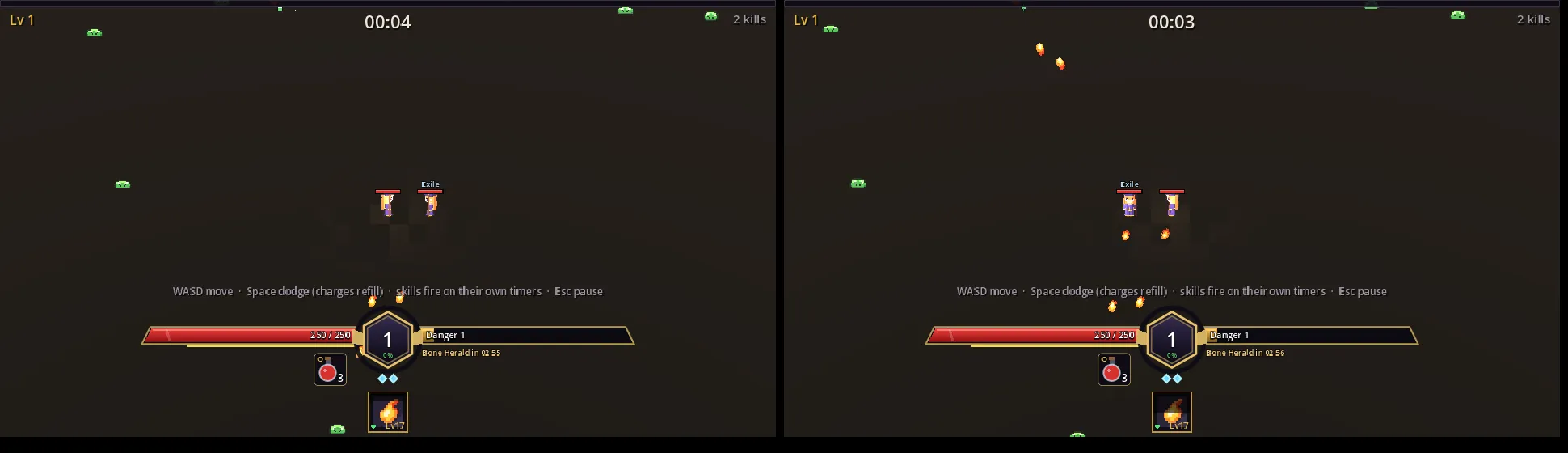
Friends can now play the Survival Rift together. This post follows the feature over four days, including the review in which we attacked our own code. The full design is in multiplayer.
The model
One player hosts and up to three join. Everyone brings their own saved character and keeps their own loot. The host runs the game as if offline; a watcher sends each client 20 Hz quantised snapshots (players, plus the monsters near that player) and, once per physics frame, a batch of events: monsters appearing and dying, projectiles, telegraphs and swings to replay locally, that player’s own drops, level-ups and gear. Clients predict their own movement and reconcile against the host, and draw everything else 100 ms in the past. Loot is instanced: every kill rolls drops for every player and each client sees only its own. A fallen player is downed until an ally stands next to them for 3 s.
Two bugs only showed up in the real two-process test (a host and two client processes on localhost):
- Godot 4.1.1 sends any RPC on a transfer channel above 0 unreliably, whatever its mode says, so “reliable” messages vanished under load. Everything is on channel 0 now.
- Client reconciliation applied the same error twice when two snapshots acknowledged the same input, and the player flew off to -48 billion.
Measured with four players at a late wave: about 40 KB/s per client and under 1 ms of host CPU. The first party scaling table doubled the monster count and the host’s physics with it, so the enemy cap grows slowly and the extra pressure comes from monster life.
Without a VPN
The owner wanted friends to join without installing a VPN, and safely. Hosting now asks the router to open UDP 7777 by UPnP, with a 2 h lease renewed while hosting and removed on Leave, at the end of a run and on quit. When the router refuses (no UPnP, or CG-NAT), the lobby says so in plain words. Router calls run on a single background worker so a slow discovery never freezes the menu.
Every lobby has a 6-character join code (no look-alike characters) that
travels in Godot’s authentication step, so the engine drops everything else a
peer sends until the code is accepted. Five wrong codes in a minute and that
address is ignored for a minute. The host also caps every client message, gives
each peer a message budget and sanity-checks the character it receives.
Two engine details: in 4.1.1, complete_auth sends its confirmation to
whichever peer was targeted last, and ENet’s plain disconnect throws away the
outgoing queue so a refusal reason never arrives (refusals use
peer_disconnect_later).
Attacking our own host
A new suite plays the stranger, the broken friend and the hostile host, with raw ENet peers that speak no Godot protocol and a second Godot process as the victim.
The worst finding wasn’t on the network side. Profile.Save opened (and so
emptied) the save file before serialising, and .NET’s JSON writer throws on NaN
or infinity. A host sending an infinite run clock made the client’s best time
infinite, and the save at the end of the run left an empty file: every
character, the stash, the orbs, gone. Saving now serialises first, refuses to
write on failure and replaces the file atomically; the client clamps every
number a host sends. A finite but absurd clock would otherwise have rolled a
hundred million reward orbs and hung the game.
On the host side, slots were the weak point: ENet had exactly three client slots, so three strangers holding code-less connections locked every friend out. Now there are 32 slots, the party size is enforced by the lobby, at most 4 connections per address wait for a code, the wait is 5 s, and the failure limiter keys IPv6 by /64 with a global ceiling. Accepted and documented: the engine reassembles even a stranger’s auth packet before our size check, and a host can still give a friend rewards within sane bounds.
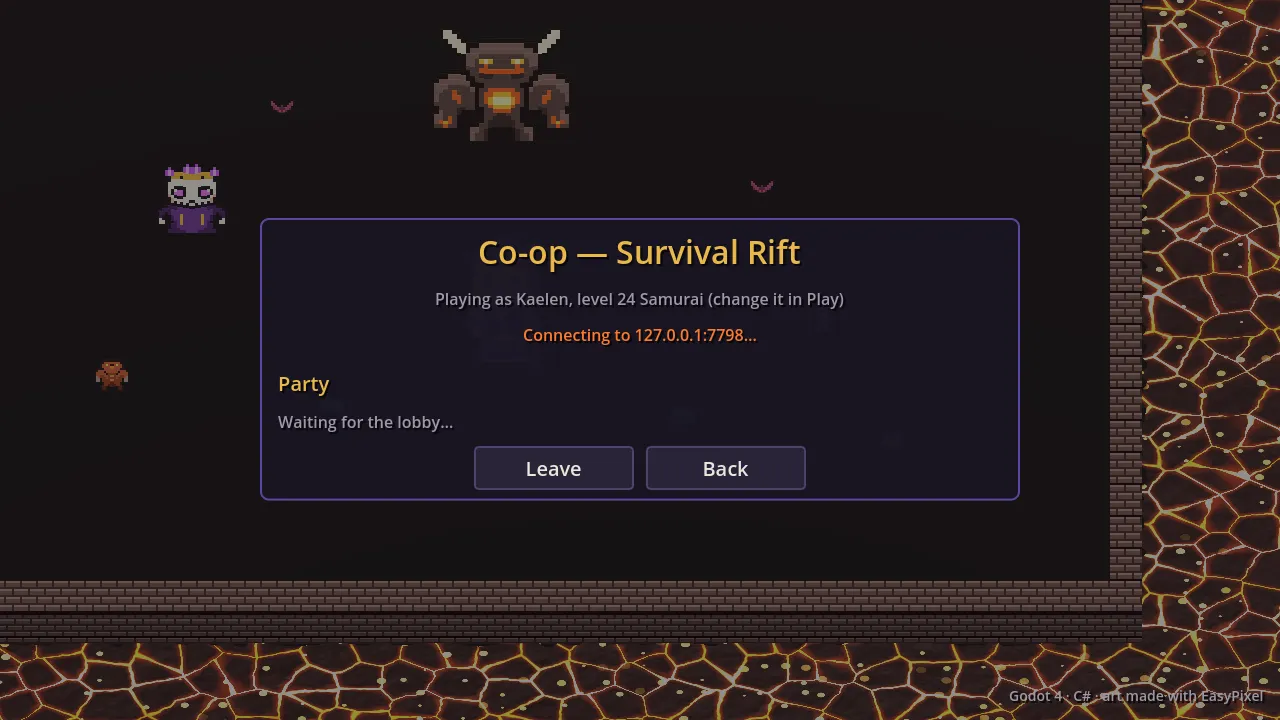
“He pressed Connect and nothing happened”
The owner tried it with a friend. Walking the screen as a first-time joiner
found it: without a character, Join was silently disabled; a dead address hid
the form behind “Connecting…” for ENet’s ~30 s with no progress or cancel; and
the address field was prefilled with 127.0.0.1:7777. The redesign shows one
state at a time: pick Host or Join; the host lobby shows the address and
code in big type, a Copy invite button, the router state and four party
slots; joining shows a spinner, the step, seconds elapsed and Cancel, and gives
up after 12 s with the real cause (couldn’t reach the host, wrong code, party
full, run already started, different versions). Before:
After:
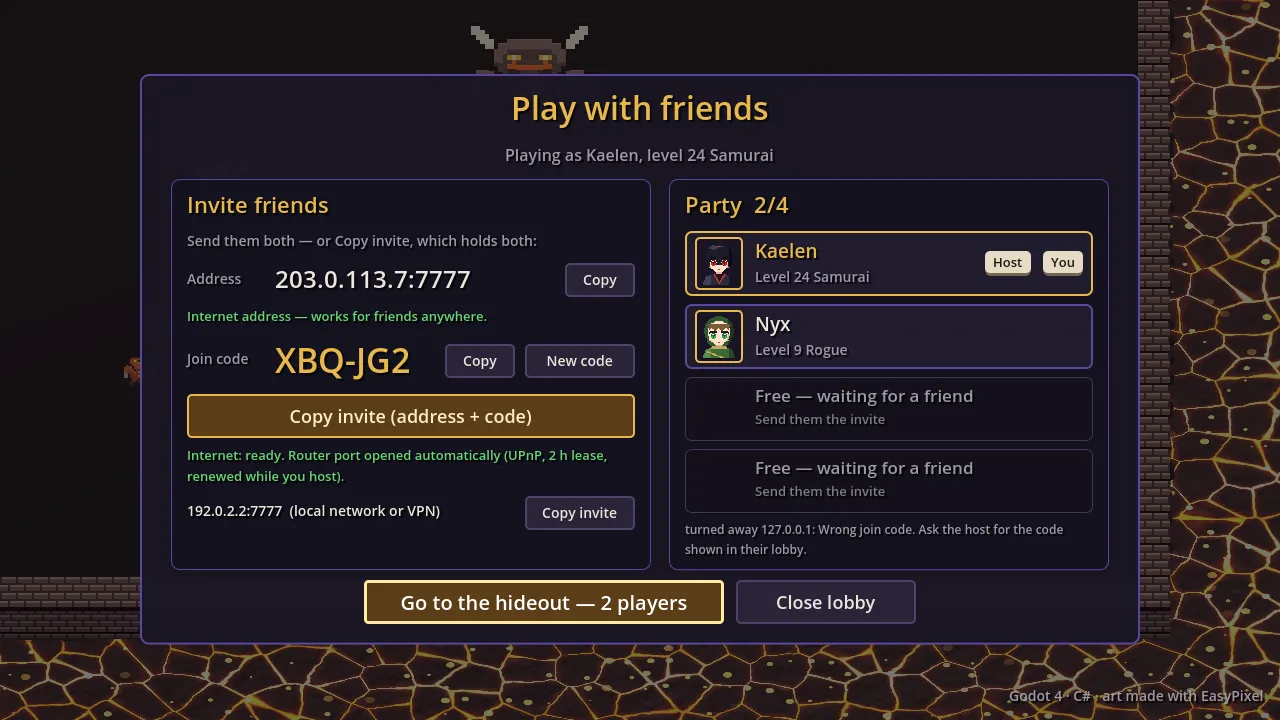
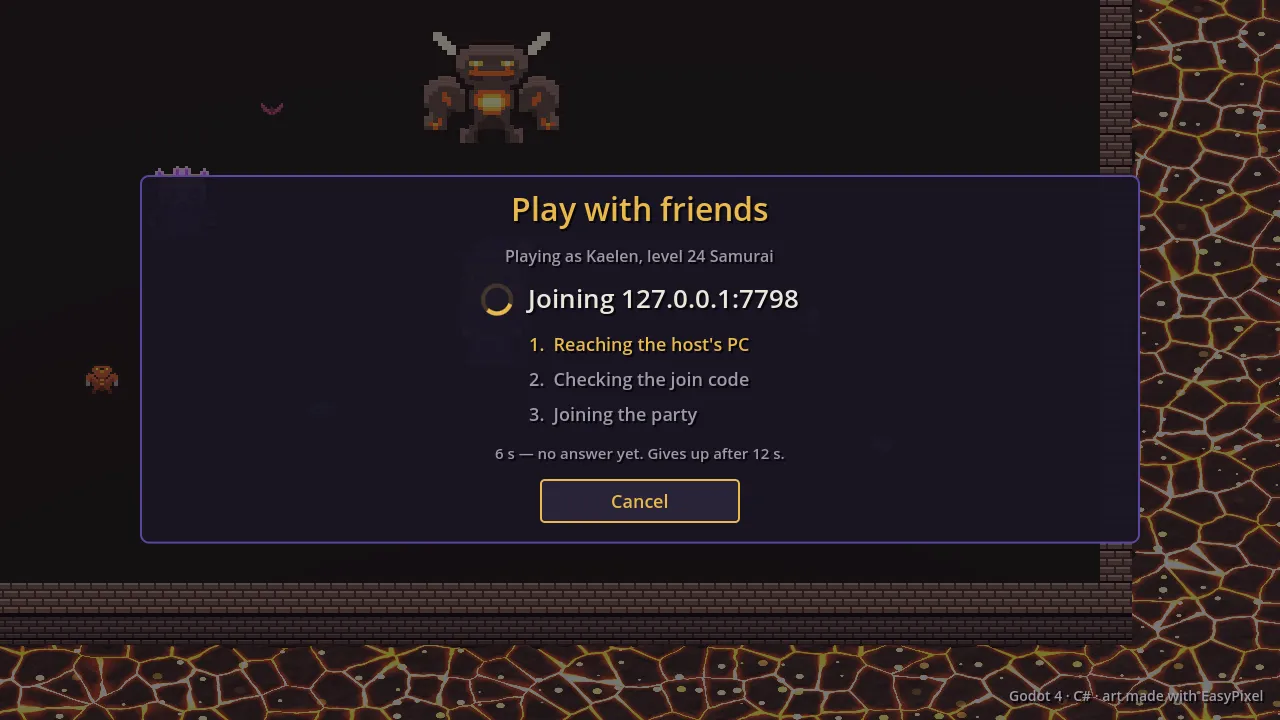
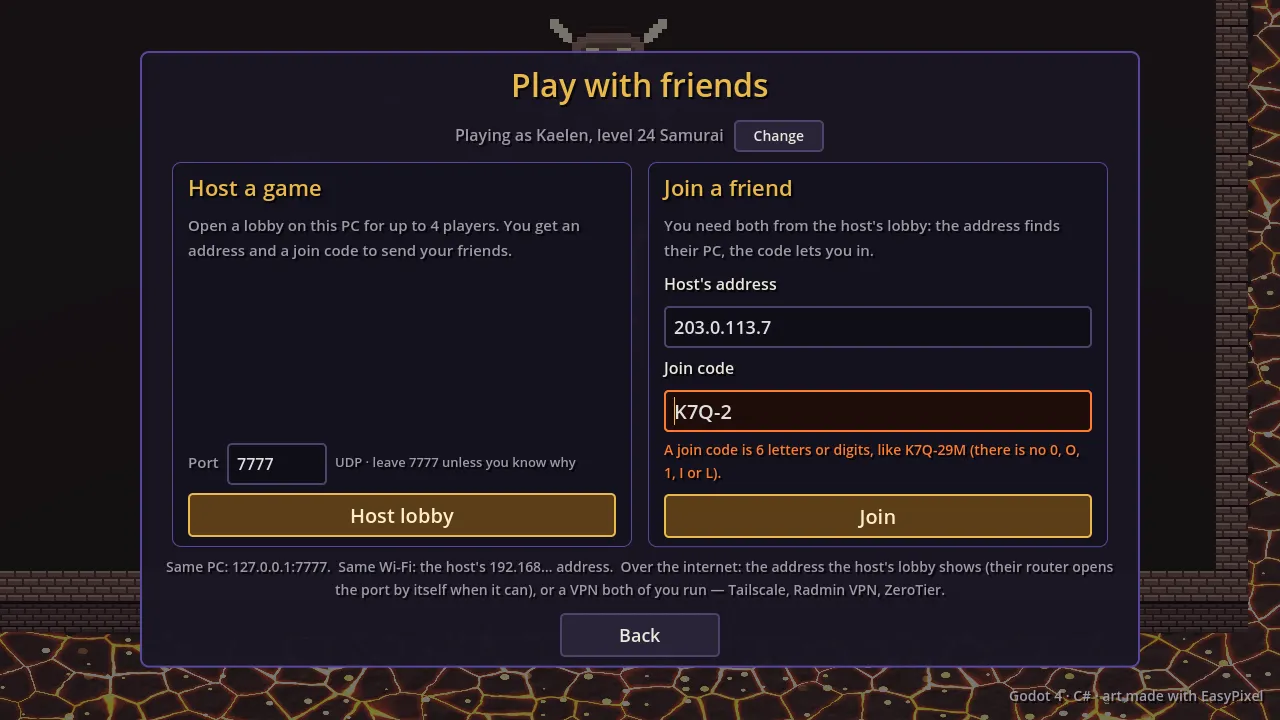
A follow-up: when UPnP failed, the big address was the PC’s LAN address. The fallback now says “Local network only” in orange and offers a Find my public IP button, which only contacts an outside service when pressed.
One bar, everyone stops, everyone picks
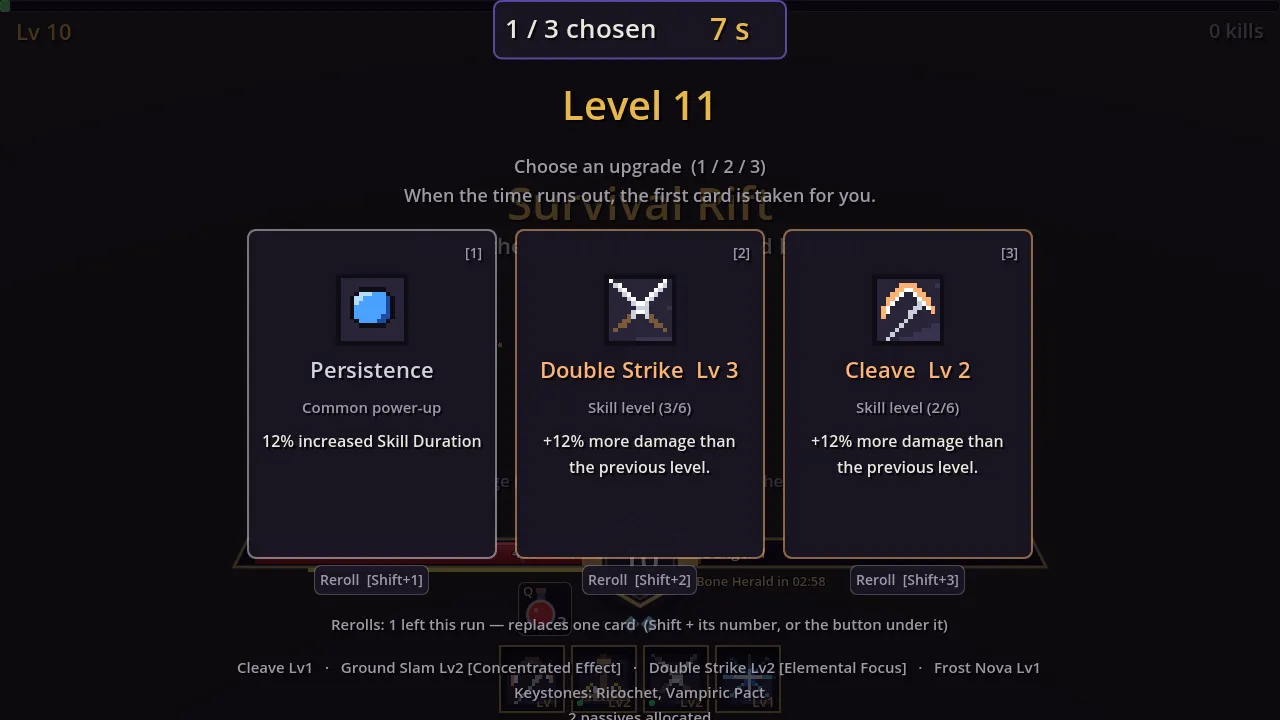
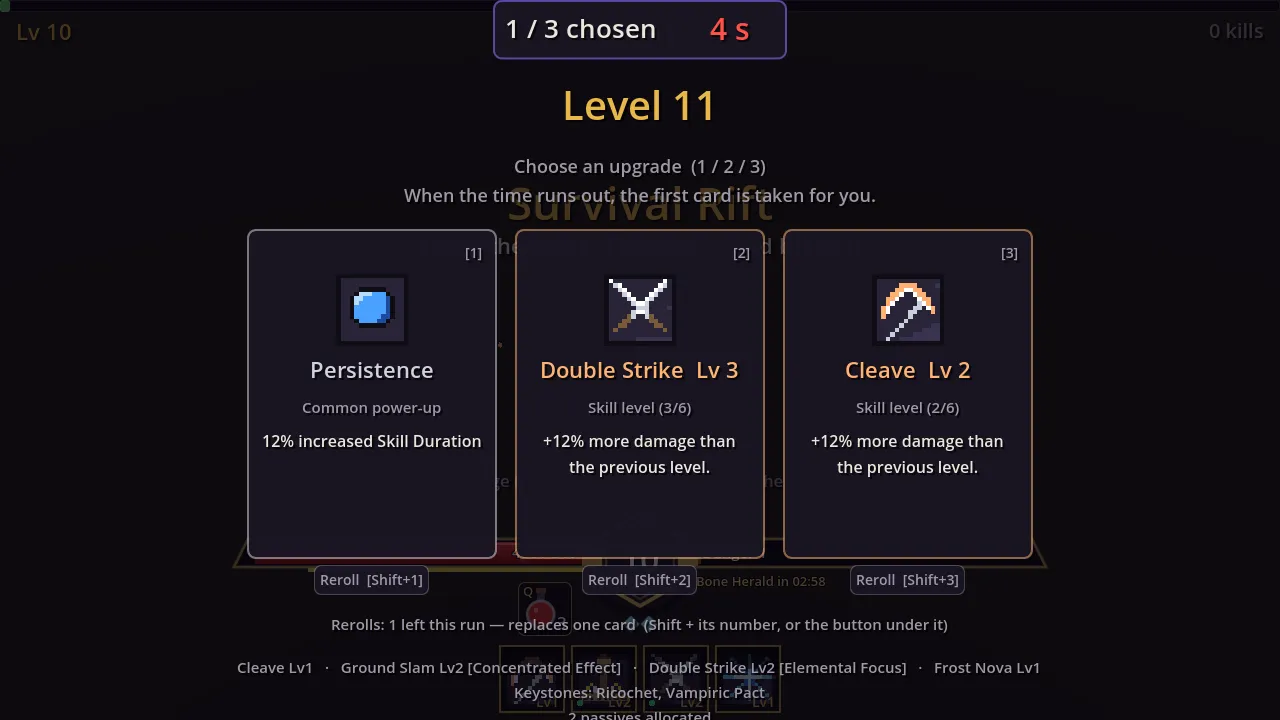
The level-up flow needed its own design. Everyone’s gems fill one party bar needing the solo amount x party size (otherwise four players would level four times as fast and pause four times as often). A level is a round: the host pauses its tree, every client pauses on receipt, and the network nodes keep running through the pause. Each player gets their own row, rolled locally; a client’s pick isn’t applied until the host validates it and answers, so a pick and the timer crossing on the wire can’t leave two copies of a build disagreeing. A “1 / 3 chosen” counter and a 10 s countdown (red at 5 s) run on the host’s clock; at the deadline the host takes the first card of each missing player’s row. After a round everyone gets 1 s of invulnerability over a 3-2-1.
Tests grew from 43 to 68 checks. A good catch: the passive card key has four parts, the first validator rejected it, and a rogue’s rows were refused with the timer picking for them.
Death rules, after the owner’s answers: solo ends the run with the reward reached; in co-op a downed player gets back up alone after 10 s at half life, or sooner at 40 % if an ally stands by for 3 s. The run ends only when everyone is down at once. The Colossus cash-out becomes a 15 s party vote where silence counts as leave.